Local Visibility
Traditional SEO vs. Google Maps Ranking: What's the Difference, and Why It Matters for Your Business
A practical guide for roofing contractors and home service companies looking to improve their local visibility and attract more qualified customers.
By Ironclad Solutions · November 10, 2026 · 6 min read
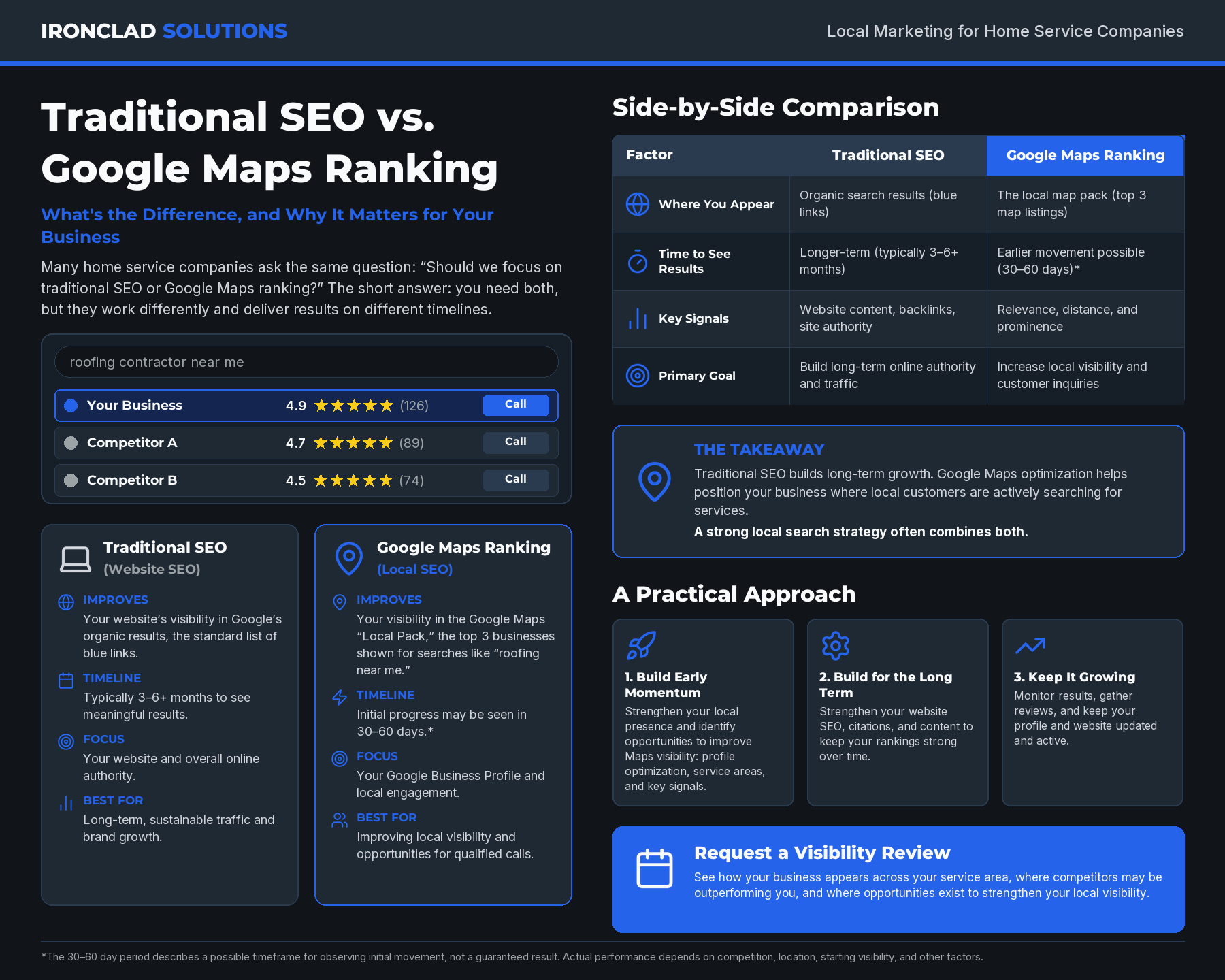
When a homeowner needs a roofing contractor, plumber, HVAC technician, or restoration company, where do they typically begin?
For many, the answer is Google.
They might search for “roofing contractor near me,” “emergency plumber,” or “HVAC repair in Seattle.”
What appears next can influence which businesses they consider contacting.
And that raises an important question for home service business owners:
Should you invest in traditional website SEO or focus on Google Maps ranking?
The answer isn’t necessarily one or the other. Both play important roles in helping potential customers find your business, but they work differently.
Understanding those differences can help you make smarter marketing decisions.
1. What Is Traditional SEO?
Traditional Search Engine Optimization (SEO) focuses on improving your website’s visibility in Google’s organic search results.
These are the standard website listings that appear when someone searches for a product, service, or information.
For example, a roofing contractor might want to appear when someone searches for:
- Roof replacement costs in Seattle
- Best roofing materials for rainy climates
- Residential roofing contractors in Bellevue
Traditional SEO generally involves improving website content, technical performance, service pages, relevant backlinks, and overall website authority.
The primary benefit: Building a stronger online presence that can attract relevant visitors over time.
However, meaningful progress often requires several months of consistent work, particularly in competitive markets.
2. What Is Google Maps Ranking?
Google Maps ranking, often called Local SEO, focuses on improving how prominently your business appears in Google’s local search results.
When someone searches for “roofing contractor near me,” Google may display a map with three featured business listings, commonly called the Local Pack.
These listings can display valuable information such as:
- Business name and location or service area
- Customer ratings and reviews
- Phone number and website
- Business hours and available services
For home service businesses, this visibility can be especially valuable because many local searches come from people actively looking for a provider.
The primary benefit: Helping your business become more visible to potential customers searching for services in your area.
Unlike traditional website SEO, Google Maps optimization places particular emphasis on your Google Business Profile and local ranking factors.
Google describes three broad factors influencing local rankings: relevance, distance, and prominence.
That means accurate business information, appropriate service categories, a strong reputation, and an established local presence all matter.
3. Traditional SEO vs. Google Maps Ranking: Which Works Faster?
One of the most common questions we hear is:
“How long before I start seeing results?”
Traditional SEO is generally a longer-term investment. Depending on competition, your website’s current condition, and the work involved, meaningful improvements may take three to six months or longer.
Google Maps optimization may show initial movement earlier. In some situations, improvements can become visible within 30–60 days.
However, those timelines are estimates, not guarantees.
Ranking improvements depend on several factors, including your current visibility, competitors, location, and the quality of your existing online presence.
And importantly, improved rankings do not automatically translate into more calls or booked jobs.
The objective should be measurable business improvement, not simply achieving a higher position for one keyword.
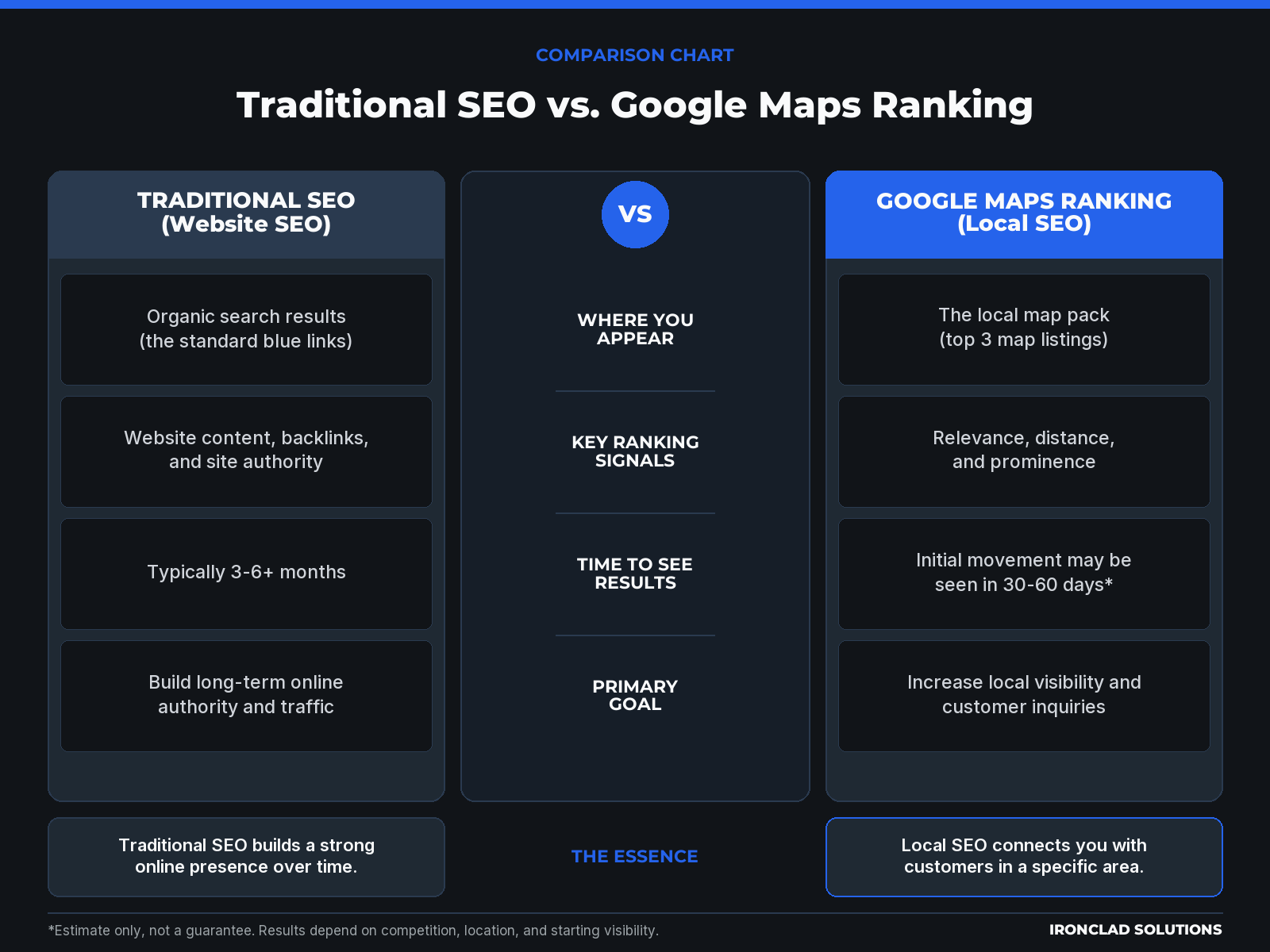
Read this comparison as text
| Traditional SEO | Google Maps Ranking | |
|---|---|---|
| Where you appear | Organic search results (the standard blue links) | The local map pack (top 3 map listings) |
| Key ranking signals | Website content, backlinks, and site authority | Relevance, distance, and prominence |
| Time to see results | Typically 3–6+ months | Initial movement may be seen in 30–60 days* |
| Primary goal | Build long-term online authority and traffic | Increase local visibility and customer inquiries |
*Estimate only, not a guarantee.
4. Why Google Maps Matters for Roofing and Home Service Companies
Consider two roofing contractors serving the same geographic area.
Both have experienced crews, competitive pricing, and positive customer reviews.
One company appears prominently in local Google Maps searches. The other is difficult to find outside its immediate neighborhood.
Even if both deliver excellent service, the more visible contractor may have more opportunities to earn inquiries from homeowners searching online.
This is why local visibility matters.
For businesses serving multiple neighborhoods or cities, it’s also important to understand that Google Maps rankings can vary significantly depending on where the person searches.
A roofing company might be highly visible near its office but much less visible ten miles away.
Being visible in one neighborhood doesn’t necessarily mean you’re visible throughout your service area.
That’s where a geographic ranking analysis can provide useful insight.
5. A Practical Approach: Build Early Momentum, Then Long-Term Growth
At Ironclad Solutions, we believe effective marketing starts with understanding where your business stands today and identifying opportunities for improvement.
Our approach centers on three priorities.
Step 1: Build Early Momentum
Start by reviewing your Google Business Profile, service categories, business information, reviews, and current visibility across your target service areas.
Identify gaps that may be limiting your local presence and prioritize the improvements most relevant to your business.
Step 2: Strengthen Your Long-Term Foundation
Support your local visibility with a well-structured website, useful service content, accurate business listings, relevant links, and appropriate technical SEO.
Traditional SEO and local optimization often reinforce each other.
Step 3: Measure, Refine, and Grow
Monitor ranking trends across your service area, Google Business Profile interactions, customer inquiries, and other relevant performance indicators.
Use that information to identify what is improving, where competitors remain stronger, and which opportunities deserve attention next.
The goal is not simply to generate reports. It’s to make better business decisions.
6. Should You Focus on SEO, Google Maps, or Both?
For most home service companies, a combination can be valuable.
Traditional SEO helps build long-term website visibility and authority.
Google Maps optimization focuses on strengthening your presence in local search results where potential customers are looking for nearby service providers.
The right investment depends on your current situation, market competition, business objectives, and available budget.
If your website already performs well but your business is difficult to find on Google Maps, local optimization may be a logical starting point.
If your Google Business Profile is performing well but your website lacks useful content and service-area coverage, broader SEO may deserve attention.
The important thing is to begin with an informed assessment rather than investing in marketing activities without a clear understanding of the opportunities.
7. Find Out How Visible Your Business Really Is
You may have a strong reputation, experienced employees, and years of successful projects.
But are homeowners finding your business when they search for the services you provide?
At Ironclad Solutions, we help home service companies understand their local online visibility, identify competitive gaps, and develop practical strategies for business growth.
Our starting point is straightforward: understand your business, review your local market, and identify opportunities worth pursuing.
Request a Local Visibility Review
See how your business appears across your service area, where competitors may be outperforming you, and where opportunities exist to strengthen your local presence.
Request a Visibility ReviewResults and timelines vary. No specific search ranking, call volume, or revenue outcome is guaranteed.
More from the Resource Center
Why Your Roofing Company Isn't Showing Up in Google's Top 3, Even With Great Reviews